Bees in Space
Bees!?

Yes, bees! 3,300 honeybees, to be precise.
Somewhere in the cobweb-filled corners of my brain, I knew that NASA had flown honeybees in space, and that the bees had adapted remarkably to the microgravity (“zero-g”) environment. When I started writing Lunar Rendezvous and creating the space stations and societies in deep space, I wanted the space stations to feel lived-in. Organic, a little humid, full of plants… and pollinators. When the reader gets to the first space station, they encounter honey bees floating through the station corridors along with the humans. The bees are making honey, and the humans are making mead from the honey.
I went back to do research about the bees that had been flown in space, to make sure this wasn’t too far-fetched, whether in an artificial gravity environment or microgravity. In 1984, Space Shuttle Challenger’s STS-41C mission’s primary objective was the Solar Max Repair Mission. However, the shuttle also carried 3,300 honeybees in a Bee Enclosure Module - the same number in a similar enclosure were kept on the ground for control. The bees did pretty well in space, and despite the disorientation, built a honeycomb… just in a different direction than those on the ground. Here’s an excerpt from the STS-41C crew logbook, which you’ll see in my book: “… by Day 7, comb well developed, bees seemed to adapt to 0-g pretty well. Many actually fly from place to place …”
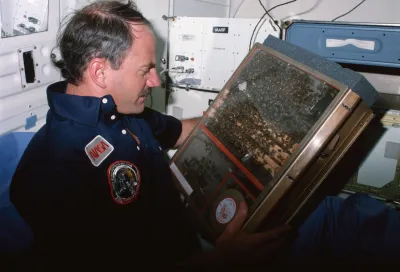
STS 41C astronaut James D. “Ox” Van Hoften examines the honeybee student experiment. From: https://www.nasa.gov/history/40-years-ago-sts-41c-the-solar-max-repair-mission/
Now one incredibly cool thing about this experiment is that a high school student came up with the concept and design of the experiment and Bee Enclosure Module. He was in college by the time it flew. He named the queen bee “Pinky” after one of the astronauts on the mission, whose call sign is “Pinky” - I carried that forward and named the bar where my two main characters meet for the first time Pinky’s.
And one last fun tidbit - you can see the flown Bee Enclosure Module on display at the Smithsonian National Air and Space Museum’s the Steven F. Udvar-Hazy Center in Chantilly, Virginia.